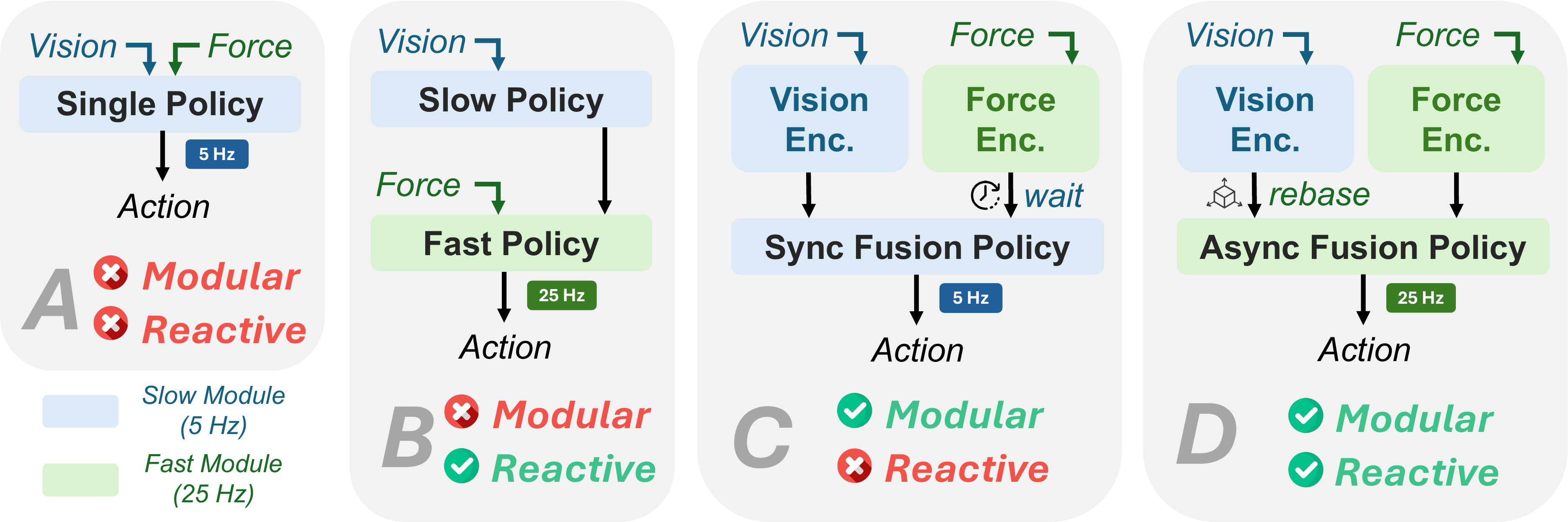
A low-frequency vision policy provides long-horizon scene guidance, while a high-frequency force/torque policy provides local contact guidance.
Under Review
LAG-Fusion
Asynchronous Multimodal Diffusion Policy Composition via Latency-Aware Guidance Fusion
Abstract.
Diffusion policies have shown strong potential for robotic imitation learning, and recent extensions incorporate additional modalities to improve manipulation performance. However, these modalities often differ not only in information content but also in sensing rates and inference latencies. Existing multimodal diffusion policies typically rely on synchronous fusion or manually designed multi-frequency architectures, which either slow down high-frequency feedback or limit extensibility to new modality combinations.
We propose LAG-Fusion, a latency-aware guidance fusion framework for asynchronous multimodal diffusion policy composition. LAG-Fusion allows modality-specific policies to operate at their native inference rates and contribute denoising guidance whenever available. To make asynchronous composition consistent, we derive a reference-frame rebasing rule for diffusion variables under relative action representations, enabling delayed guidance to be aligned before fusion. We instantiate LAG-Fusion in contact-rich manipulation by composing a low-frequency vision policy with a high-frequency force policy. Experiments under heterogeneous modality latencies show that LAG-Fusion improves policy responsiveness and task performance over synchronous fusion and specially designed force-aware baselines.
Method.
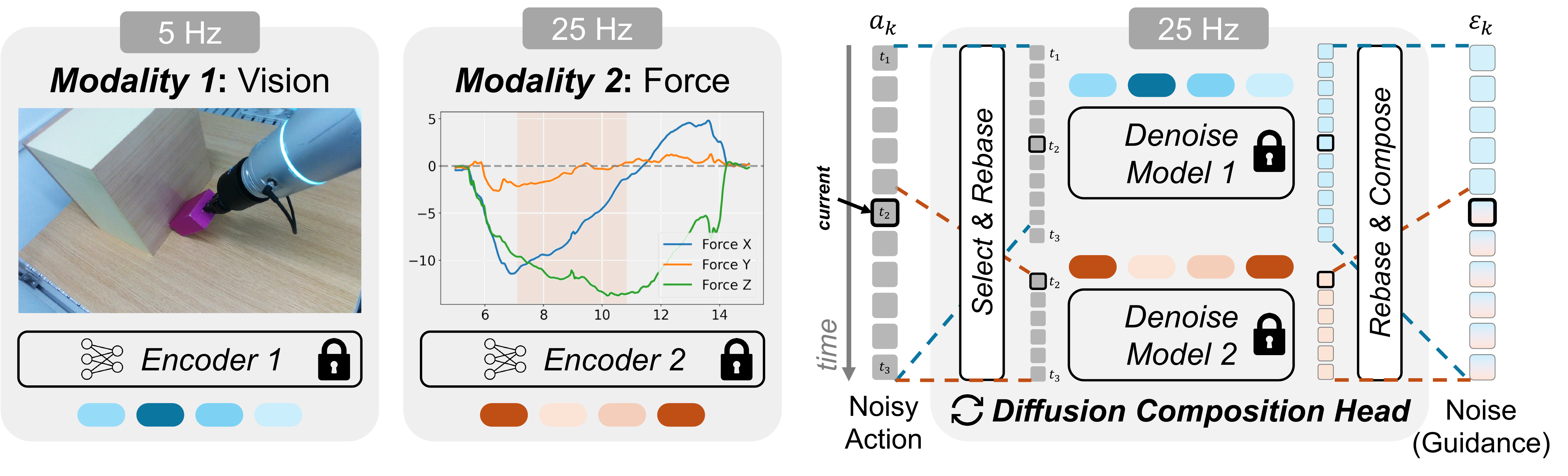
LAG-Fusion composes modality-specific diffusion policies at their native inference frequencies.
In the diffusion composition head, the overlapping noisy action segment is rebased into the current force frame for force denoising. The corresponding vision guidance is rebased to the same frame, fused with force guidance, and mapped back to update the full-horizon noise prediction.
Reference-frame Rebase.
Delayed guidance is still expressed in the action frame at its original query time. Before fusion, LAG-Fusion transforms every diffusion variable from the old frame T1 into the current frame T2.
01
Relative action
Full affine transform
02
Noisy sample
Offset scaled by the diffusion schedule
03
Predicted noise
Orthogonal linear transform only
Key property. Because the linear part is orthogonal, rebasing preserves the standard Gaussian diffusion distribution.
Detailed derivation
The delayed prediction is expressed in the robot frame at query time t1, while fresh force guidance is expressed in the current frame at t2. The derivation below shows how to express clean actions, noisy samples, and predicted noises in the same frame without changing the Gaussian diffusion distribution.
Transform from the old frame to the current frame
Let T1 and T2 be the robot poses at the two policy-query times. The relative transform contains a rotation and a translation:
This rigid-body transform is independent of the action-coordinate representation. The next step chooses coordinates that make its action-space rebase affine with an orthogonal linear part.
Write the 10D action rebase as an affine map
Each relative action is represented by 3D translation, 6D rotation, and one gripper value:
Because R2←1 is a rotation matrix, the linear part A2←1 is orthogonal.
Apply the affine rebase to the clean-action estimate
For diffusion timestep k, the clean action estimated from noisy sample ak and predicted noise εk is:
Rebase this clean estimate with the affine action transform and regroup it into the standard diffusion-estimator form:
Read off the rebase rules
Comparing the regrouped expression with the standard estimator in frame T2 gives:
The translation offset enters the noisy sample with the schedule-dependent factor √ᾱk, but it is never added to the noise. Since A2←1A2←1T = I, transforming ε ∼ 𝒩(0, I) by A2←1 preserves its covariance and therefore the standard Gaussian diffusion distribution.
Latency-Aware Guidance Fusion.
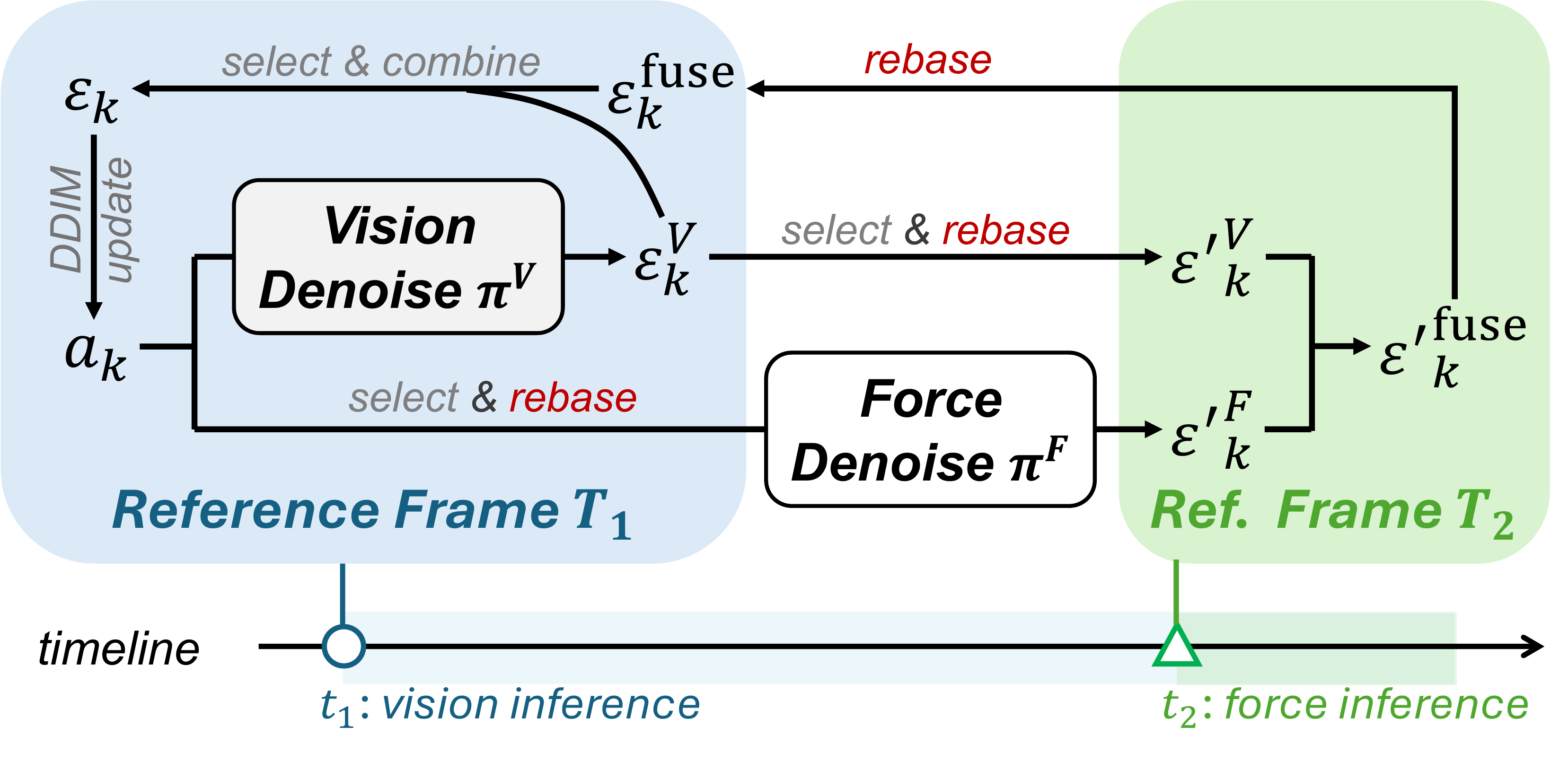
- Selectthe overlapping segment of the vision action horizon.
- Rebasethe noisy sample and delayed vision guidance into the current force frame.
- Fusealigned vision and force guidance using latency-aware weights.
- Map backthe fused guidance to update the full diffusion trajectory.
Experiments.

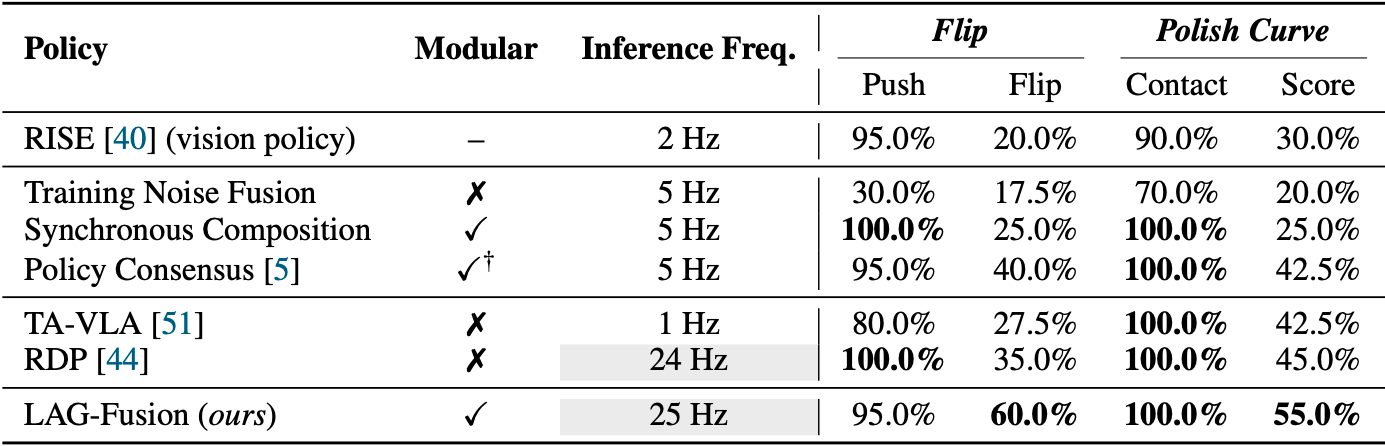
Evaluation Videos — Flip
Evaluation Videos — Polish Curve
Frequency Study.
Higher Infer Frequency → Higher Success Rate
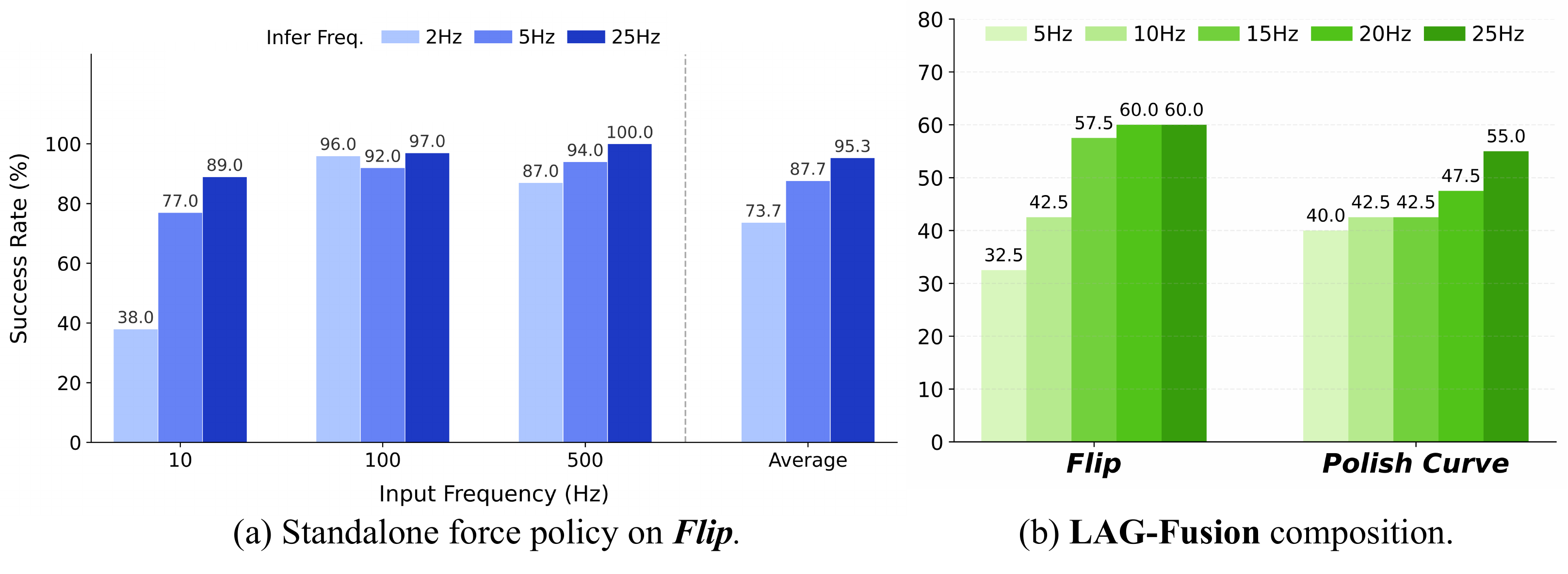
Infer Freq.: 2 Hz73.7%Average across input frequencies
Infer Freq.: 5 Hz87.7%Average across input frequencies
Infer Freq.: 25 Hz95.3%Average across input frequencies
Standalone Force Policy — 500 Hz Input / 25 Hz Inference
Citation.
@misc{he2026asynchronousmultimodaldiffusionpolicy,
      title={Asynchronous Multimodal Diffusion Policy Composition via Latency-Aware Guidance Fusion},
      author={Zihao He and Hongjie Fang and Shirun Tang and Cewu Lu and Haoshu Fang},
      year={2026},
      eprint={2607.17257},
      archivePrefix={arXiv},
      primaryClass={cs.RO},
      url={https://arxiv.org/abs/2607.17257},
}